
A car accident can happen anywhere in Oklahoma. Whether you’re driving through downtown Oklahoma City, heading home in Ardmore, traveling along I-44 near Tulsa, or navigating one of Oklahoma’s many rural highways, a crash can leave you shaken, injured, and unsure what to do next.
The minutes, hours, and days after an accident can have a major impact on both your health and your ability to recover financial compensation. Unfortunately, insurance companies begin evaluating claims almost immediately. The steps you take—and the mistakes you avoid—can make a significant difference in the outcome of your case.
At Colbert Cooper Hill, we help injured people throughout Oklahoma from our offices in Oklahoma City, Ardmore, and Tulsa. We know how confusing the aftermath of a collision can be and can help you protect your rights from day one.
Use this checklist after any Oklahoma car accident to help protect both your health and your legal claim.
RELATED: 10 Mistakes to Avoid After an Oklahoma Car Accident
✓ Stay at the Scene of the Accident
Your first responsibility after a collision is to remain at the scene.
Even if the accident seems minor, do not leave until you’ve exchanged information with the other driver and spoken with law enforcement, if required. Oklahoma law requires drivers involved in accidents involving injury, death, or significant property damage to remain at the scene.
If you don’t: Leaving the scene could expose you to criminal penalties and make it much harder to pursue compensation for your injuries.
✓ Check for Injuries and Call 911
If able, check yourself, passengers, and other parties involved for injuries. If anyone appears injured (or if you’re unsure) call 911 immediately.
Even injuries that seem minor should be evaluated by emergency medical personnel. Conditions such as internal bleeding, traumatic brain injuries, and spinal injuries aren’t always immediately obvious after a crash.
Emergency responders can also begin documenting injuries that later become important evidence in your claim.
If you don’t: Delaying emergency care could allow serious injuries to worsen and may give insurance companies an opportunity to argue your injuries weren’t caused by the crash.
✓ Move to Safety If Possible
If your vehicle can safely be moved, pull it out of traffic and turn on your hazard lights.
If the vehicle cannot be moved safely, leave it where it is and move yourself and any passengers to a safe location away from traffic, if possible. Do not move anyone you suspect may have a spinal or neck injury unless it is absolutely necessary.
If you don’t: Secondary crashes are unfortunately common after an initial collision, particularly on busy highways like I-35, I-40, I-44, and the Turner Turnpike. Remaining in active traffic can place everyone involved at risk of additional collisions.
✓ Call Law Enforcement
Even if the accident seems straightforward, having an official police report can become extremely important later. The responding officer will document:
- Driver information
- Witness statements
- Road conditions
- Vehicle damage
- Initial observations
- Potential traffic violations
This report often becomes one of the first documents insurance companies review when evaluating fault.
Ask the responding officer how you can obtain a copy of the completed crash report.
✓ Exchange Information
Even if police are on scene collecting information, personally gather the following information from every involved driver if you can:
- Full name
- Address
- Phone number
- Driver’s license number
- Insurance company
- Policy number
- License plate number
- Vehicle make and model
Remain polite but keep the conversation brief. Do not argue about who caused the accident or apologize. Even a simple statement like “I’m sorry” could later be interpreted as an admission of fault.
✓ Identify Witnesses
Independent witnesses can become some of the strongest evidence available.
If anyone saw the collision happen, ask for their name, phone number, and email address.
Witnesses often leave quickly once emergency responders arrive, so gathering their information early can be invaluable.
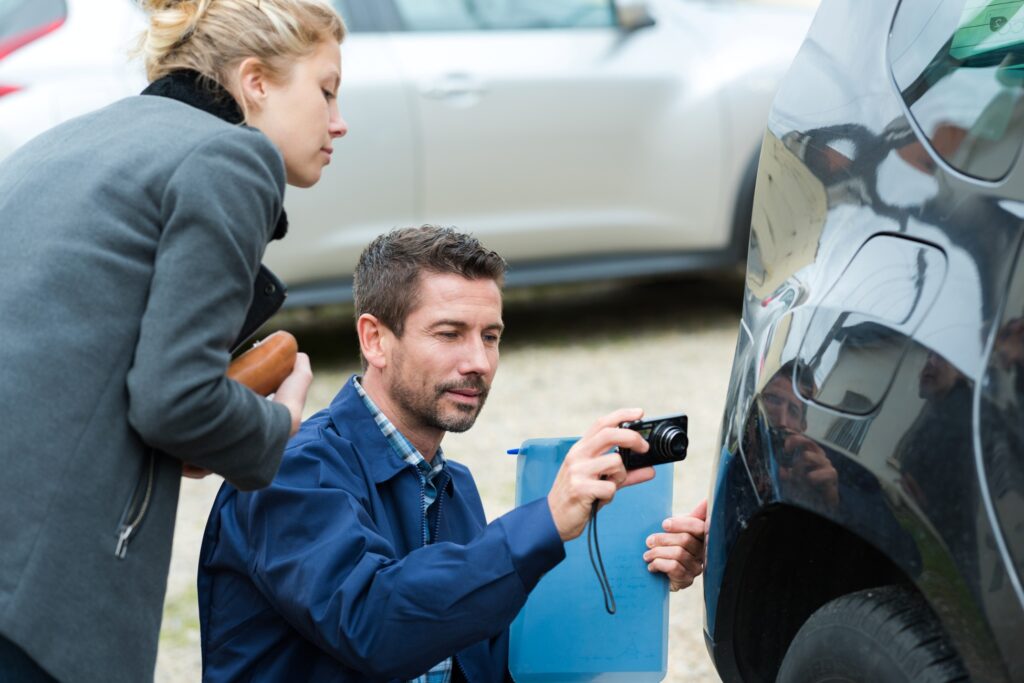
✓ Take Photos and Videos
Having clear images of the scene right after the accident can be valuable evidence. If it is safe to do so, photograph:
- Every vehicle involved
- Damage from multiple angles
- License plates
- Roadway conditions
- Traffic signals
- Skid marks
- Debris
- Weather conditions
- Visible injuries
- Nearby businesses or surveillance cameras
Take more photographs and videos than you think you’ll need. Evidence can disappear quickly after an accident.
✓ Write Down Everything You Remember
Memory fades surprisingly fast. As soon as you’re able, write down everything you remember, including:
- Where you were traveling
- Direction each vehicle was traveling
- Approximate speeds
- Weather conditions
- Traffic conditions
- What happened immediately before impact
- Statements made by the other driver
These notes may become valuable months later if litigation becomes necessary.
✓ Seek Medical Treatment Immediately
We know we already discussed calling 911 if needed, but this is different.
Many people feel relatively fine immediately after a crash because adrenaline temporarily masks pain. However, injuries commonly diagnosed days later include:
- Whiplash
- Concussions
- Soft tissue injuries
- Herniated discs
- Internal bleeding
- Knee injuries
- Shoulder injuries
Even if emergency responders examine you at the scene, you should still schedule a complete medical evaluation as soon as possible. Follow every recommendation your examining physician gives you.
Insurance companies often argue that gaps in treatment mean your injuries were not serious. Establishing a medical record and following medical advice as early as possible can help counter these allegations.
RELATED: Delayed Symptoms After a Car Accident: Why You Should Act Early
✓ Notify Your Insurance Company
Report the accident to your own insurance company promptly.
When speaking with your insurer, stick to the facts of your case. Don’t speculate, guess, or exaggerate anything.
Simply explain what happened and answer only the questions you know the answers to. Being honest and saying you don’t know is preferable to making a guess that can later be declared wrong.
✓ Be Careful When the Other Insurance Company Calls
It often doesn’t take long before the at-fault driver’s insurance company reaches out.
Their adjuster may sound friendly, but remember why they’re calling. Their goal is to save their company money—not maximize your recovery.
The adjuster might ask you to give a recorded statement, sign medical releases, or accept a quick settlement. Politely decline in each case until you’ve spoken with an Oklahoma car accident attorney.
RELATED: How to Deal with An Insurance Adjuster After a Car Accident in Oklahoma
✓ Don’t Accept the First Settlement Offer
Many insurance companies move quickly after an accident. They know you may be overwhelmed by mounting medical bills, missed paychecks, vehicle repairs, and family needs.
Insurers understand this pressure and might offer a quick settlement offer hoping you will accept it. However, these offers are frequently made before the full extent of your injuries is even known.
Once you accept a settlement, you generally cannot go back and ask for additional compensation, even if your condition becomes much worse later.
RELATED: Do I Have to Accept the First Insurance Company Offer?
✓ Keep Every Receipt and Record
Your damages—and what you may have the right to recover—extend well beyond emergency room bills. Keep records of:
- Medical bills
- Prescription costs
- Physical therapy
- Mileage to appointments
- Lost wages
- Repair estimates
- Rental car expenses
- Insurance correspondence
- Out-of-pocket expenses
These records help demonstrate the true financial impact of your accident.
RELATED: What Types of Compensation Can You Seek in a Personal Injury Claim?
✓ Avoid Posting About the Accident on Social Media
Insurance companies routinely review public social media accounts.
Even innocent posts can be taken out of context. For example, a photograph of you smiling at a family gathering could be used to argue you aren’t experiencing pain.
Until your case is resolved, it’s often best to avoid discussing your accident or injuries online altogether.
RELATED: What to Do (And Not Do) During an Ongoing Personal Injury Claim
✓ Continue Following Your Treatment Plan
Healing doesn’t stop after your first doctor’s appointment.
Attend:
- Follow-up visits
- Physical therapy
- Specialist appointments
- Imaging appointments
If your doctor recommends restrictions, follow them.
Missing appointments can weaken both your recovery and your legal claim.

✓ Contact an Experienced Oklahoma Car Accident Lawyer
One of the most important steps after a car accident in Oklahoma is speaking with an experienced attorney before making important decisions about your case.
Insurance companies have experienced adjusters and lawyers working to minimize what they pay. You deserve someone working just as hard for you.
At Colbert Cooper Hill, The Wolf Pack™ investigates every aspect of your accident.
Depending on your case, we may:
- Preserve critical evidence
- Obtain crash reports
- Interview witnesses
- Locate surveillance footage
- Work with accident reconstruction experts
- Review medical records
- Calculate your future damages
- Handle negotiations with insurance companies
- Prepare your case for trial if necessary
Our goal is simple: recover every dollar you deserve while allowing you to focus on healing.
Whether your accident happened in Oklahoma City, Ardmore, Tulsa, or anywhere else in Oklahoma, our car accident attorneys are ready to help.
RELATED: Will My Personal Injury Case Go to Trial?
Contact The Wolf Pack™ After an Oklahoma Car Accident
After a serious collision, you shouldn’t have to fight insurance companies alone.
From the moment you contact Colbert Cooper Hill, we’ll begin evaluating your case, preserving important evidence, and helping you understand your legal options.
We know the tactics insurance companies use to reduce or deny valid claims. We’ve also seen firsthand how devastating a serious accident can be for Oklahoma families.
That’s why we’re committed to fighting aggressively for compensation that reflects the true cost of your injuries including medical bills, lost wages, pain and suffering, future medical care, and other damages allowed under Oklahoma law.
If you’ve been injured in a car accident anywhere in Oklahoma, contact The Wolf Pack™ today to request a free case review.
The content provided here is for informational purposes only and should not be construed as legal advice on any subject.